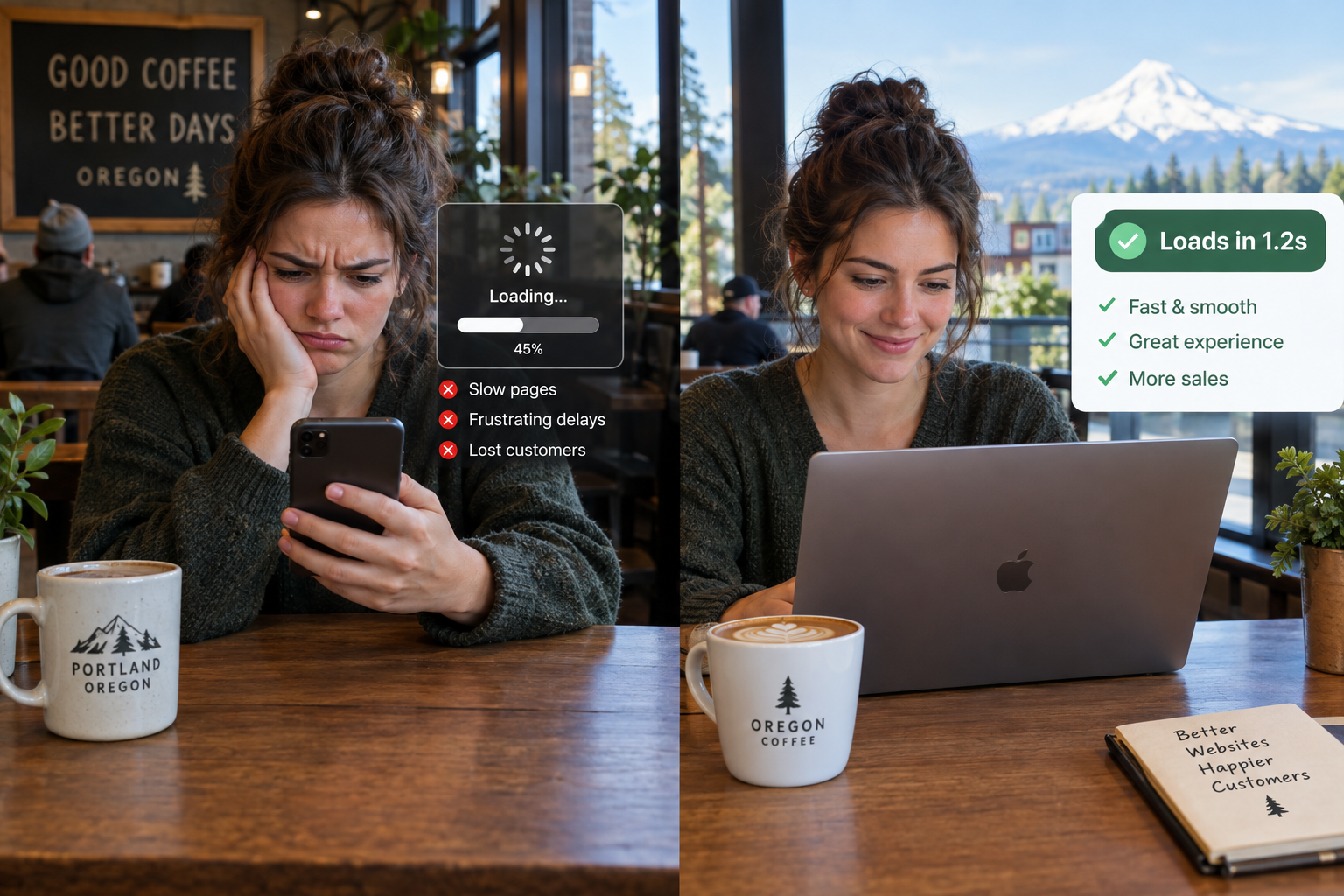
A slow website loses customers because people searching for a local business are usually in a hurry, and they will leave a page that does not appear quickly. Search engines also pay attention to how a page feels to use, so slow sites tend to be harder to find as well as harder to enjoy. For Oregon businesses, from a Portland plumber to a Bend coffee roaster, speed is one of the few improvements that helps both visibility and the number of visitors who turn into calls, bookings, and sales.
Why speed matters for local customers
Think about how people search locally. Someone stands in a parking lot, needs a service, and pulls out a phone. They tap a result, and if nothing appears within a few seconds, they go back and tap the next one. You rarely see that visitor in your analytics as a complaint. They simply vanish, and a competitor gets the call.
Mobile connections in real life are not always fast. Visitors may be on a weak signal in the Columbia River Gorge, on crowded public Wi-Fi in a downtown cafe, or on an older phone. A site that feels quick on your office computer may feel painfully slow to them.
How speed connects to search visibility
Google has said that page experience is one of many factors it considers, including how quickly a page loads, how stable it looks while loading, and how fast it responds when someone taps. Speed will not rescue a page with thin or unhelpful content, but among similar local businesses it can be the tiebreaker.
The bigger effect is often indirect. A fast site keeps visitors engaged, which means they read more, click to call, and fill out your form. A slow site pushes them back to the results page. Those behaviors reflect real customer satisfaction, and a site that serves people well is easier to grow over time.
The most common causes of slow sites
Most speed problems come from a short list of causes, and many are fixable without rebuilding anything.
- Large photos uploaded straight from a camera or phone without being resized or compressed
- Too many plugins, scripts, chat widgets, and tracking tools running on every page
- Cheap or overloaded hosting that responds slowly before the page even begins loading
- Heavy page builders and themes that load far more code than the page needs
- Web fonts, sliders, and background videos that delay the first view of the page
- No caching, so the site rebuilds the same page for every single visitor
Often one or two of these items cause most of the delay, so finding the biggest offender first saves a lot of effort.
Francisco Labs builds fast sites from the start: Our websites use lightweight, hand-tuned code, properly sized images, and mobile-first layouts so Oregon businesses load quickly on any device. If your current site feels sluggish, we can find the bottlenecks and show you what a faster version would look like.
How to check your own site
You do not need special skills to get a useful first look. Open your site on your phone using mobile data, not your home Wi-Fi, and pay attention to how long it takes before you can read the page and tap a button. Notice whether things jump around as the page loads, which is frustrating on a small screen.
Free tools such as Google PageSpeed Insights and the Core Web Vitals report in Google Search Console give a more detailed view. They highlight specific problems and suggest fixes. Do not obsess over a perfect score. Focus on the issues flagged for your most important pages, usually the homepage and your main service pages, and on whether the site feels fast to a real person.
Practical fixes that make the biggest difference
Start with images, since they are usually the largest files on a page. Resize them to the size they are actually displayed, compress them, and use modern formats where your platform supports them. Load images below the first screen only as visitors scroll toward them.
Next, remove what you do not need. Delete unused plugins, retire old tracking scripts, and question every widget that loads on every page. Choose reliable hosting with good performance, and turn on caching if your platform offers it. Keep fonts simple, and avoid autoplay video at the top of the page. Each change is small, but together they often make a site feel dramatically better.
Make speed part of your routine
Speed is not a one-time project. Sites slow down gradually as new photos, plugins, and features are added. Build a few habits to keep things fast, such as compressing images before uploading, reviewing plugins every few months, and testing key pages after any major change.
If your website was built years ago or relies on a heavy template, a rebuild may be more effective than patching. A lean, modern site gives Oregon customers a better experience and gives your local search efforts a stronger foundation. Customers rarely tell you when a site is too slow, so measure it, fix it, and keep it that way.
Is a slow website costing you customers?
Francisco Labs designs fast, mobile-first websites for Oregon businesses that want to be found and chosen. Let's talk about getting your site up to speed.
Start a Project