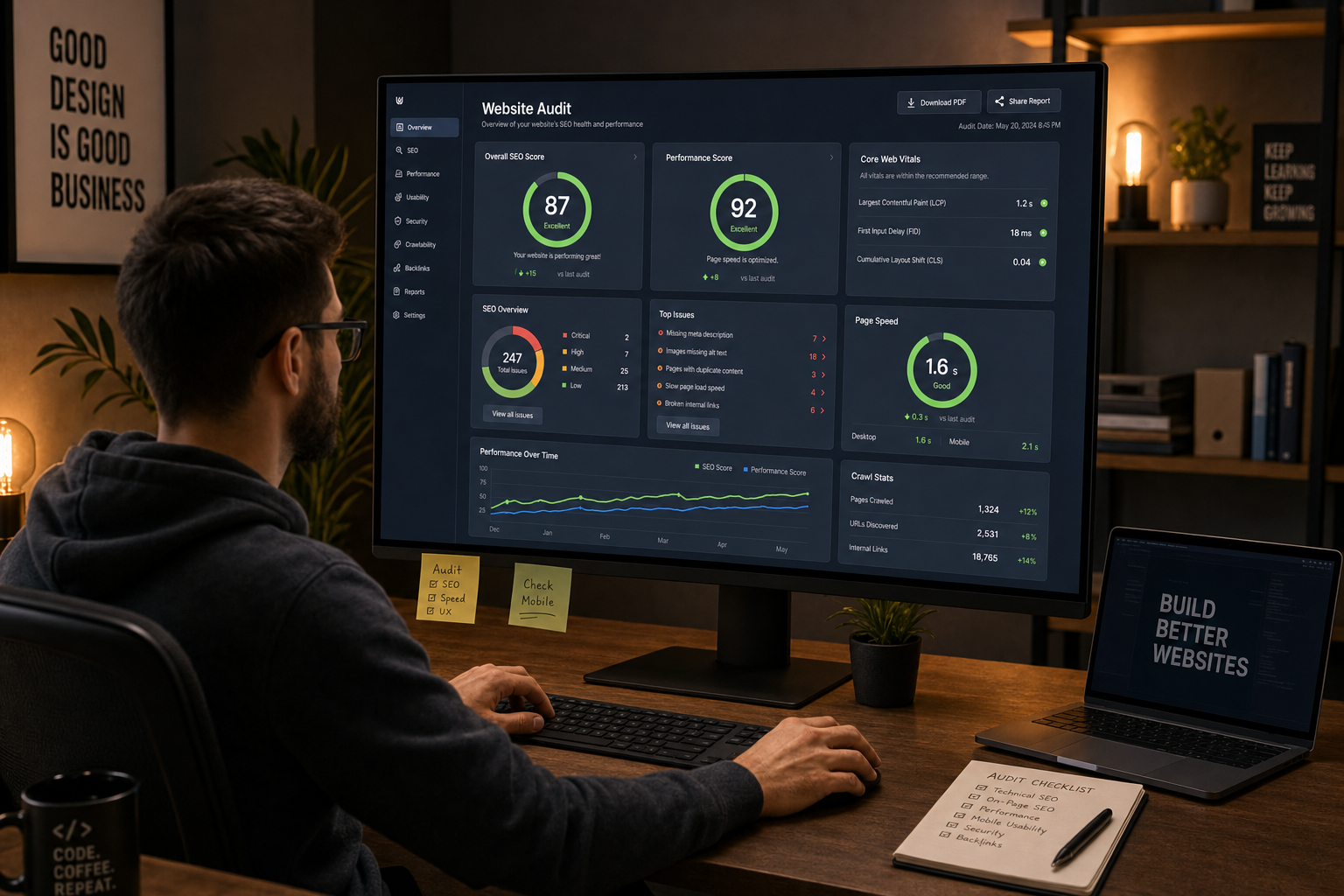
Most small business websites in Oregon are not invisible because they lack content — they are invisible because they have specific, fixable technical and on-page SEO gaps that prevent search engines from understanding what the site is about and where it should rank. A structured audit identifies those gaps in under an hour using tools that are freely available, and gives you a prioritized list of improvements that tend to produce measurable results relatively quickly for local search.
Start With the Basics: Indexing and Crawlability
The first question in any audit is whether the site can actually be found and read by search engines. A website that has crawl errors, a disallow rule in its robots.txt, or pages set to noindex cannot rank regardless of how good the content is. These issues are more common than most business owners expect, particularly on older websites or sites built on platforms where settings were accidentally changed.
Google Search Console is the most reliable tool for checking indexing status. If the business does not have Search Console set up, that alone is a significant gap — Search Console provides data on which pages are indexed, which have errors, and what queries are generating impressions. Setting it up and verifying the property is typically a ten-minute task and provides baseline data that is unavailable anywhere else.
For sites without Search Console access, typing site:businessdomain.com into Google shows how many pages are indexed. A site with dozens of pages but only two or three showing in this search has an indexing problem that needs to be identified before working on anything else.
On-Page Signals: Title Tags, Meta Descriptions, and Headers
Once you have confirmed the site is being crawled and indexed, the next layer is on-page signals — the elements that tell both search engines and users what each page is about. For local Oregon businesses, this is frequently where the most significant gaps appear.
Title tags are the single most important on-page element. Check whether each page has a unique title tag that includes the primary service or product and the city or region. A cleaning company in Eugene whose homepage title reads only "Home" or the business name alone is missing one of the clearest signals it could send. A title like "House Cleaning Services Eugene, Oregon | [Business Name]" is dramatically more specific and more likely to appear for relevant local searches.
Meta descriptions do not directly affect rankings, but they influence click-through rates — how often someone who sees the result in search actually clicks on it. A missing or auto-generated meta description leaves that impression on the table. Each page should have a unique, benefit-oriented description of 140 to 160 characters that compels the searcher to visit.
Header structure (H1, H2, H3 tags) tells search engines how the content is organized. Each page should have exactly one H1 tag that describes the page's primary topic, ideally incorporating the target keyword and location. Subheadings (H2 and H3) should organize the content logically and introduce supporting topics naturally rather than forcing keywords in where they do not fit.
Francisco Labs audits and rebuilds Oregon small business websites with local SEO built in from the start. If your site is not generating the leads it should, the issue is usually fixable — and faster to resolve than most business owners expect. Let's take a look at your site.
Local SEO Signals: NAP Consistency and Schema
For local businesses in Oregon, on-page SEO and local SEO overlap substantially. The most important local signals are name, address, and phone number (NAP) consistency and structured data markup.
NAP consistency means the business name, address, and phone number appear in exactly the same format on the website as they do on Google Business Profile, Yelp, the Oregon state business registry, and any other directory where the business is listed. Even minor variations — abbreviating "Street" to "St" in some places but not others — can create ambiguity that reduces local ranking confidence. The website's footer and contact page should match the primary Google Business Profile listing exactly.
Structured data, specifically LocalBusiness schema markup, tells search engines explicitly that the site represents a local business — its category, address, hours, service area, and phone number in a machine-readable format. Many small business websites in Portland and across Oregon have no schema markup at all, which is a straightforward technical gap. Adding LocalBusiness schema to the homepage and contact page requires modest technical effort but sends a clear, unambiguous signal about what the business is and where it operates.
Page Speed and Mobile Usability
Page speed and mobile usability are ranking factors and user experience factors simultaneously — a slow or broken mobile experience affects both how Google ranks the site and how often visitors convert into customers. Google's PageSpeed Insights tool provides a score and a prioritized list of improvements for any publicly accessible URL, requiring no login or setup.
The most common speed issues for small business sites are oversized images that have not been compressed or resized for web delivery, render-blocking JavaScript or CSS that delays the page from appearing, and hosting on slow or shared servers that add significant time to initial load. Images are the most frequent culprit and the easiest to address — converting large JPEG or PNG hero images to properly sized WebP files typically produces the most immediate speed improvement.
Mobile usability should be tested directly on a phone, not just by resizing a browser window. Navigation that works on desktop sometimes breaks on mobile, text that is readable at 1200px becomes too small at 375px, and buttons that are easy to click with a mouse can be frustratingly small on a touchscreen. For Oregon businesses where a meaningful portion of searches happen on mobile — particularly in service categories like cleaning, landscaping, and food — these usability gaps translate directly into lost leads.
Content Gaps: Are There Pages for What You Do?
The final audit layer is content coverage. A site that has only a homepage, an about page, and a contact form cannot rank for more than a handful of searches. Each service the business offers, and each city or neighborhood it serves in Oregon, is a potential page that could rank independently and capture searchers at the exact moment they are looking for what the business provides.
For a business serving multiple Oregon cities — say, a window tinting shop serving Portland, Beaverton, Gresham, and Hillsboro — dedicated landing pages for each city allow the site to appear in local searches across the entire service area rather than only in the city where the business is physically located. This content structure is one of the most reliable drivers of expanded local search visibility and one of the most commonly missing elements in small business websites across the state.
Fix your site's SEO gaps — and start getting found
Francisco Labs builds and optimizes websites for Oregon small businesses that want real local search visibility. From technical SEO to content structure to Google Business Profile, we handle the full picture. Let's talk.
Start a Project