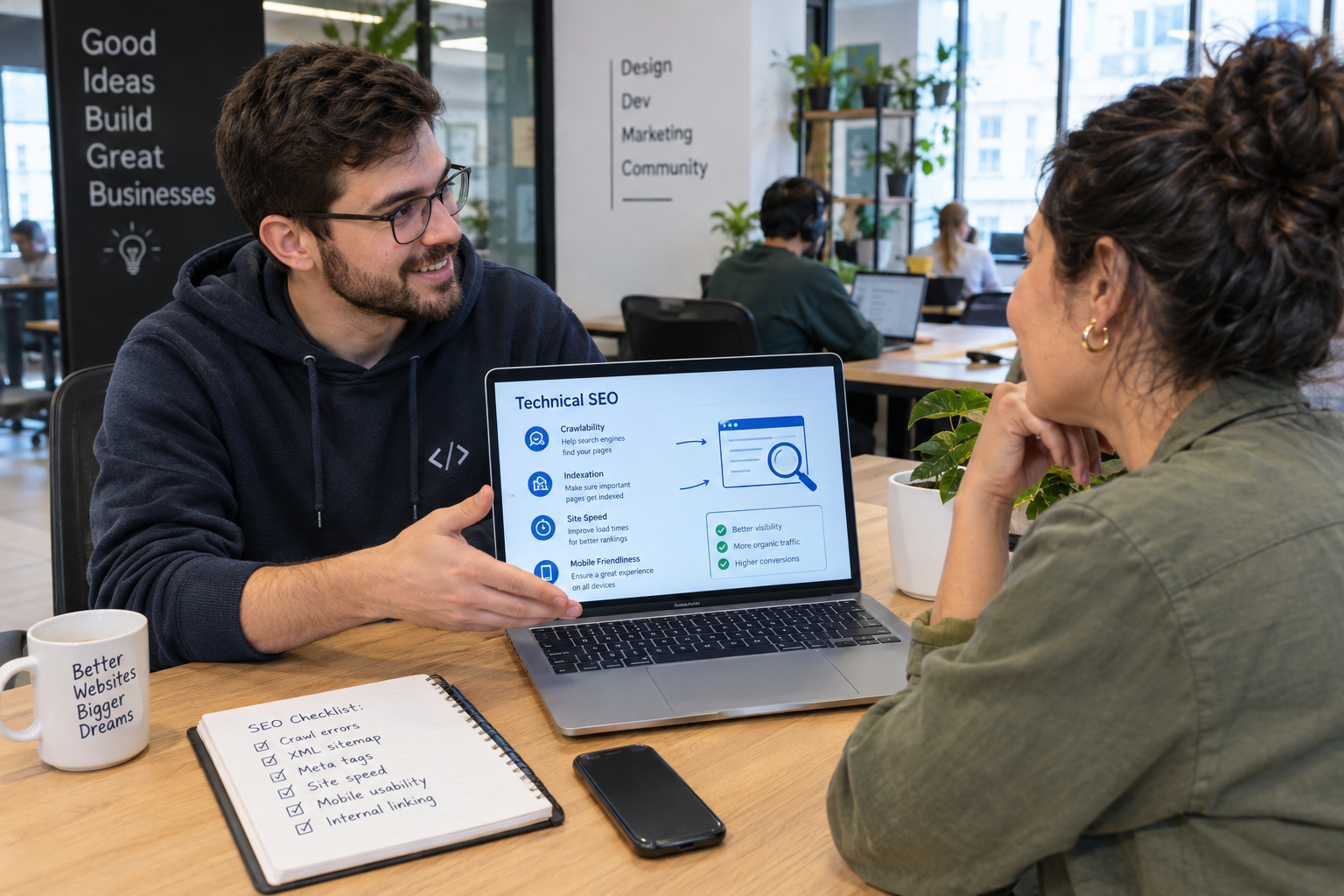
Technical SEO is the behind-the-scenes work that makes sure search engines can find your website, read it correctly, and trust it enough to show it to customers. You do not need to write code to understand it. Think of your website as a storefront: great products and friendly service do not help if the door is locked, the sign is unreadable, or the address is wrong on the map. For Oregon small businesses competing in Portland, Eugene, Bend, and beyond, getting these basics right is often the quiet difference between showing up in local search and being overlooked.
What technical SEO actually means
Search engines send automated programs to visit websites, read the pages, and decide what to show for each search. Technical SEO is everything that helps those programs do their job well, plus everything that keeps real visitors from getting frustrated.
It covers how fast your pages load, whether your site works on a phone, whether it is secure, and whether search engines are allowed to see your pages at all. It is separate from the words you write and the links you earn, but it supports both. Great content on a broken site rarely gets the attention it deserves.
Speed and mobile friendliness
Most local searches happen on a phone, often by someone who wants an answer quickly. If your site takes too long to appear, jumps around while loading, or forces visitors to pinch and zoom, they will leave and search engines notice.
- Large, uncompressed photos are the most common cause of slow pages and are usually easy to fix.
- Text should be readable without zooming, and buttons should be easy to tap.
- Pop-ups that cover the content on a phone frustrate visitors and can hurt your visibility.
The simplest test is to open your own site on your phone using mobile data, not Wi-Fi, and ask whether a stranger would stay.
Security and a clean foundation
A secure site uses HTTPS, which you can spot by the padlock icon in the browser address bar. Browsers warn visitors about sites that lack it, and few customers will submit a form on a page marked as not secure.
Clean structure matters too. Every page should have a unique, descriptive title and a short description of what it covers. Pages should link to each other in a logical way, and broken links, the ones that lead to errors, should be fixed or redirected. When you move or rename a page, set up a redirect so that old links and search results still lead somewhere useful.
Francisco Labs handles the technical side so you can focus on your business: From fast, mobile-first builds and clean site structure to sitemaps, structured data, and local SEO foundations, we make sure Oregon businesses are easy for both customers and search engines to find. If you suspect your site has hidden problems, let's take a look together.
Helping search engines find and understand your pages
Two simple files help search engines navigate your site. A sitemap is a list of the pages you want found, and a robots file tells search engines which areas to skip. Mistakes here can cause real damage, such as accidentally telling search engines to ignore your whole site, which sometimes happens when a developer leaves a setting on after launch.
Structured data is another useful tool. It is a small piece of hidden code that labels facts about your business, such as your name, address, phone number, hours, and the services you offer. It helps search engines read your information accurately and can support how your business appears in results. Connecting your site to Google Search Console, a free tool from Google, lets you see which pages are indexed and which problems Google has found.
Local details that matter in Oregon
For local businesses, technical accuracy extends beyond your website. Your business name, address, and phone number should match exactly across your site, your Google Business Profile, and the directories where you appear. If you serve several cities, such as Portland, Beaverton, and Hillsboro, give each important service area its own useful page instead of a single long list.
Make sure your phone number is a tap-to-call link on mobile, your address links to a map, and your contact form actually delivers messages to an inbox you check. These small technical choices turn a visit into a call or request, which is the real goal of local SEO.
How to start without feeling overwhelmed
You do not have to fix everything at once. A practical order is to check mobile usability and speed first, confirm the site is secure, set up Google Search Console, and then review page titles and broken links. Write down what you find, fix the most visible problems, and revisit the list every few months.
If the list feels too technical, that is a good moment to bring in help. A trusted web professional can run a full check in a short time, explain the findings in plain language, and prioritize what will make the biggest difference. Technical SEO is not about tricks. It is about removing obstacles so that the good work your business already does can be seen by the Oregon customers searching for it.
Not sure what is holding your website back?
Francisco Labs builds and tunes fast, secure, search-ready websites for Oregon small businesses. Let's find the hidden problems and fix them.
Start a Project