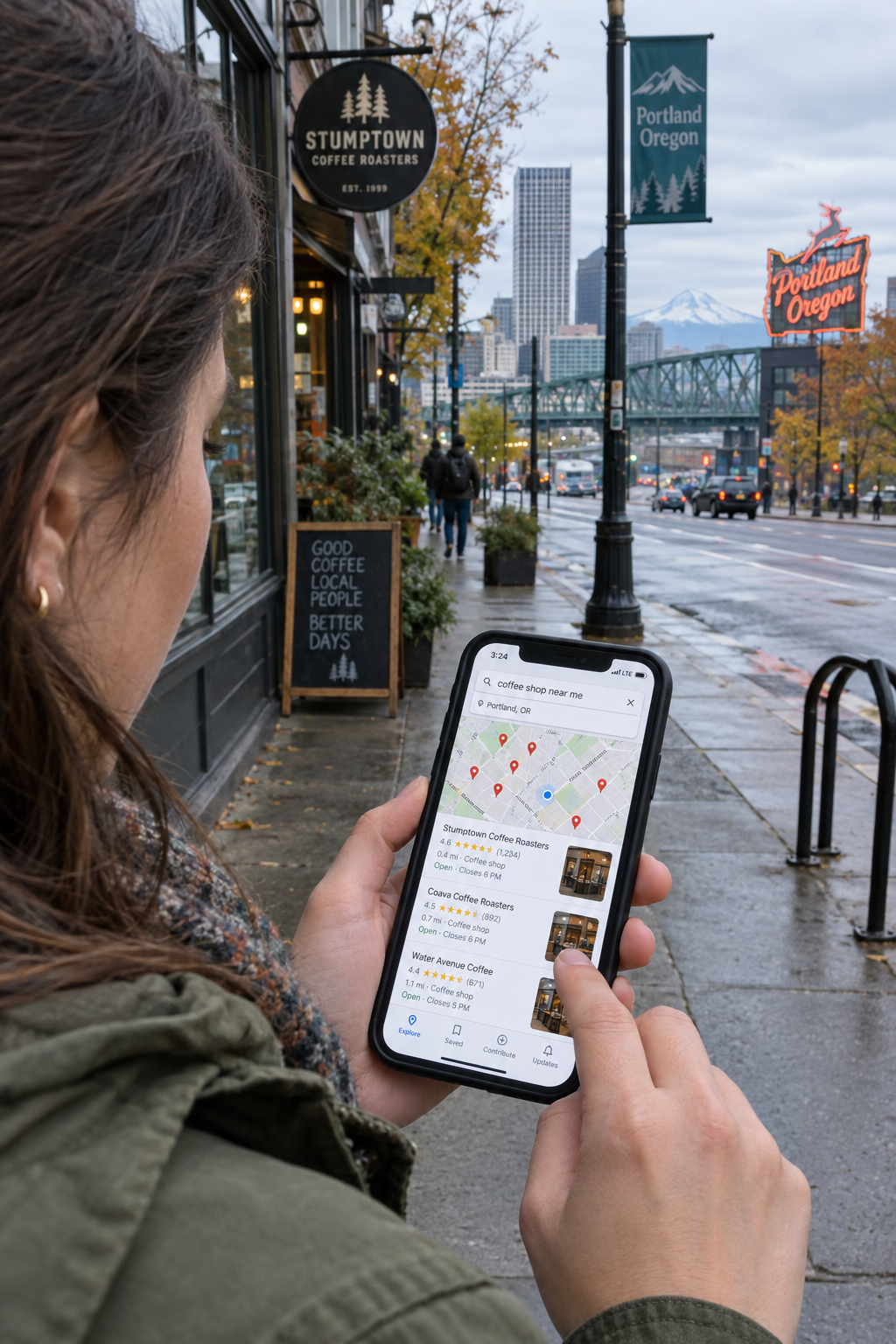
A bad phone experience costs Oregon businesses customers because most local searches now happen on a phone, often by someone who needs an answer right away. If your site is slow, hard to read, or awkward to tap, that person simply goes back to the results and chooses the next business. A good mobile website does the opposite. It loads quickly, shows what you do and where you are, and makes calling, booking, or asking for a quote effortless, all within a few seconds on a small screen.
How local customers use their phones
Think about the moments when people search for local businesses. Someone is walking through downtown Portland looking for lunch, a homeowner in Beaverton has a burst pipe, or a visitor in Bend wants a tire shop that is open right now. These searches are urgent, specific, and often made one-handed with a weak signal.
That urgency changes what a website needs to do. Visitors are not browsing for entertainment. They want to confirm that you offer what they need, that you are nearby, and that they can reach you. Every extra step, pop-up, or tiny button between them and that answer is a reason to leave.
Common mobile mistakes that cost business
Most poor mobile experiences come from a handful of fixable problems. Many sites were designed on a desktop computer first and then squeezed onto a phone as an afterthought.
- Text that is too small to read without pinching and zooming
- Buttons and links packed so closely together that they are hard to tap
- Phone numbers that are plain text instead of tap-to-call links
- Pop-ups and banners that cover the page and are hard to close
- Menus that are confusing, hidden, or too long for a small screen
- Forms with too many fields that are frustrating to complete with a thumb
- Large images and heavy features that make the page slow on mobile data
Any one of these can lose a customer. Together, they make a site feel unfinished, which reflects on the quality of the business behind it.
Francisco Labs designs mobile first: Every site we build starts with the phone experience, with clear calls to action, tap-to-call buttons, short forms, and fast loading on any connection. If your current website frustrates visitors on a phone, we can show you what a better version looks like for your Oregon business.
What a good mobile experience looks like
The best mobile sites are simple and focused. The first screen tells visitors who you are, what you do, and where you serve, with a visible way to call or request help. Navigation is short and clear, and the most important actions are always within thumb reach.
- A prominent call button and a short contact or quote form
- Readable text and generous spacing between tappable elements
- Your address linked to a map and your hours easy to find
- Fast loading with properly sized images
- Reviews, photos, and trust signals placed near the action buttons
Less is often better. A phone screen rewards clear hierarchy, concise copy, and one obvious next step.
Why it matters for local search
Search engines evaluate the mobile version of your site when deciding how to rank it, so a weak phone experience can hold back your visibility as well as your conversions. A site that is easy to use on mobile also tends to keep visitors longer and earn more calls, which supports your local results.
It also affects how your Google Business Profile performs. Customers who tap through from your profile land on your website, and if that page disappoints them, the strong first impression you built there is wasted. Your listing and your site should work together as one smooth path from search to contact.
How to test your own site
You can check your mobile experience in a few minutes. Pull out your phone, switch off Wi-Fi, and search for your own business the way a customer would. Try to find your phone number, your hours, and your main service. Tap the call button, open the menu, and fill out the contact form.
Ask a friend, a family member, or a customer to try it too, since fresh eyes notice problems you no longer see. Google Search Console also reports mobile usability issues for your pages. Write down every frustration, fix the biggest ones first, and test again. If the list is long, a rebuild focused on mobile may serve you better than patching an old design. Either way, treating the phone as your main storefront is the surest way to turn Oregon searches into customers.
Does your website work well on a phone?
Francisco Labs builds fast, mobile-first websites for Oregon businesses that want more calls and bookings. Let's talk about your site.
Start a Project