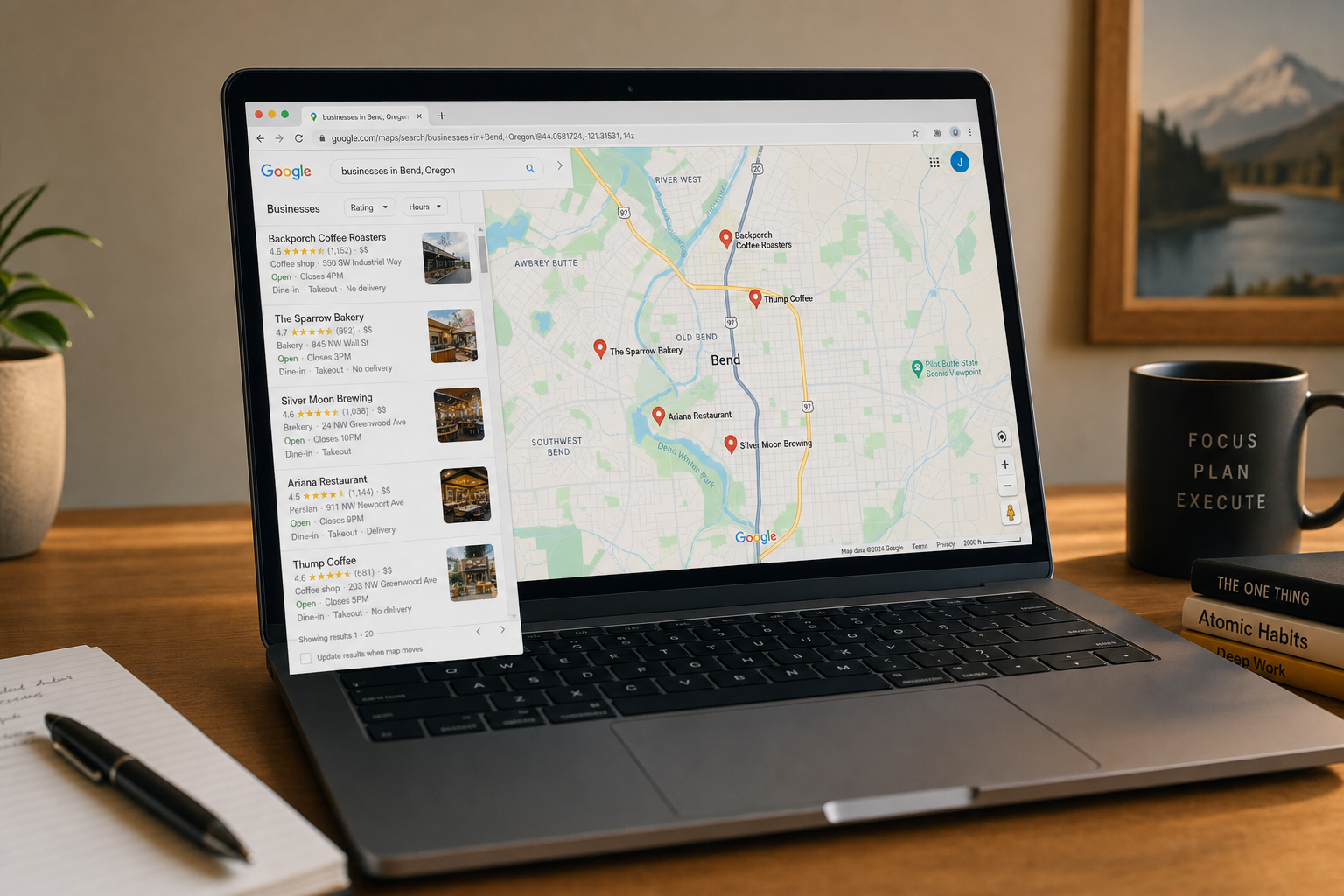
Google Maps is one of the most practical and underused tools for understanding local business activity across Oregon — and it costs nothing. Whether you are prospecting for new clients, researching a market, or evaluating competitors, the map gives you a real-time view of who is operating, how active they are, and where gaps exist. The key is knowing what signals to look for and how to use them systematically.
Why Google Maps Reveals More Than a Directory
Traditional business directories give you a static list. Google Maps gives you a layered picture of how businesses are actually performing in their local market. A listing on Maps is tied to a Google Business Profile, which means you can see review counts, average ratings, posting frequency, photos, hours, and service descriptions — all in one place.
In Oregon, where markets range from the dense commercial corridors of Portland and Eugene to the more spread-out business communities in Medford, Bend, and the coast, the map is especially useful because it lets you segment by geography instantly. You can zoom to a specific neighborhood in Northeast Portland or pull back to see all the auto repair shops along a corridor in Salem. That flexibility makes it a powerful research tool regardless of what sector you are working in.
Reading a Listing for Activity Signals
When you open a business listing on Google Maps, the most useful signals are often not the obvious ones. The star rating matters, but the real intelligence lives in the details that most people scroll past.
- Review recency: A business with many reviews but nothing in the past several months may be declining in customer activity or has stopped asking for reviews. Both are worth noting.
- Owner responses: Businesses that consistently reply to reviews are actively managing their online presence. Businesses that never reply often lack digital infrastructure.
- Photos and updates: Recent photos, updated hours, and active Google Posts signal a business that treats its profile as a living asset rather than a one-time setup.
- Category and service descriptions: These tell you exactly how the business wants to be found and what it considers its core offer — valuable context before any outreach conversation.
When you are reviewing listings across a market, you quickly develop a sense for which businesses are invested in their digital presence and which are largely absent. That distinction often maps directly onto which ones are most open to a conversation about improvement.
Using the Map for Systematic Prospecting
The most effective way to use Google Maps for prospecting is to treat it as a structured research session rather than casual browsing. Start with a specific geography and a specific business type. For example, searching "landscaping companies Portland Oregon" or "cleaning services Bend Oregon" returns a cluster of pins with enough profile data to make an initial assessment of each listing without ever leaving the map.
From there, you can build a simple working list. Note the business name, approximate location, review count, rating, last activity date, and any obvious gaps in their profile — missing website, few photos, outdated hours. Businesses with visible gaps tend to be the easiest to open a conversation with because there is a clear, concrete improvement on the table.
This process scales well across Oregon's varied markets. A morning spent on the map covering Portland's inner eastside, a few neighborhoods in Eugene, and the commercial streets of Corvallis can surface more qualified prospects than a full day of cold list purchasing — and the information is current.
Francisco Labs works with Oregon service businesses to strengthen their Google Business Profiles, improve local search visibility, and build the digital infrastructure that turns online attention into real inquiries. If you are seeing gaps in your own profile or your competitors', let's talk about what's possible.
Comparing Competitors Across a Local Market
Google Maps also makes competitive landscape analysis straightforward. When you search a service category and location, you can compare the top-ranked listings side by side. Pay attention to what the highest-ranked businesses have in common: review volume, consistent photo uploads, detailed service listings, and active owner engagement. Those are the elements that Google's local ranking algorithm tends to reward.
For a business looking to improve its own visibility, this comparison work is valuable because it sets a concrete benchmark. If every competing landscaper in your area has more than a hundred reviews and you have twelve, that gap is not mysterious — it is a campaign problem that has a solution. If your competitors are all missing detailed service pages, that is an opening to differentiate.
The map does not tell you everything, but it tells you enough to form a hypothesis about where a market stands and where a well-positioned business could stand out.
Integrating Map Research Into a Repeatable Workflow
The businesses that get the most out of Google Maps research are the ones that do it consistently rather than occasionally. A light weekly review of your own listing — checking new reviews, updating photos, confirming hours — keeps the profile fresh and signals activity to Google. A monthly pass through competitor listings tells you whether the competitive landscape is shifting and whether anyone new has entered the market.
For agencies and consultants working with Oregon businesses, building a simple research template helps standardize this work. A spreadsheet with columns for business name, location, rating, review count, last review date, profile completeness score, and notes gives you a starting point for every new market you enter. Over time, patterns emerge that make prospecting faster and outreach more targeted.
Google Maps is not a silver bullet, but for anyone working in local business development in Oregon, it is close to a daily utility. The businesses that treat it that way tend to find and act on opportunities that others miss entirely.
Ready to strengthen your local presence?
Francisco Labs builds modern digital systems for Oregon businesses — including Google Business Profile optimization, local SEO, and websites that convert local traffic into real leads.
Start a Project