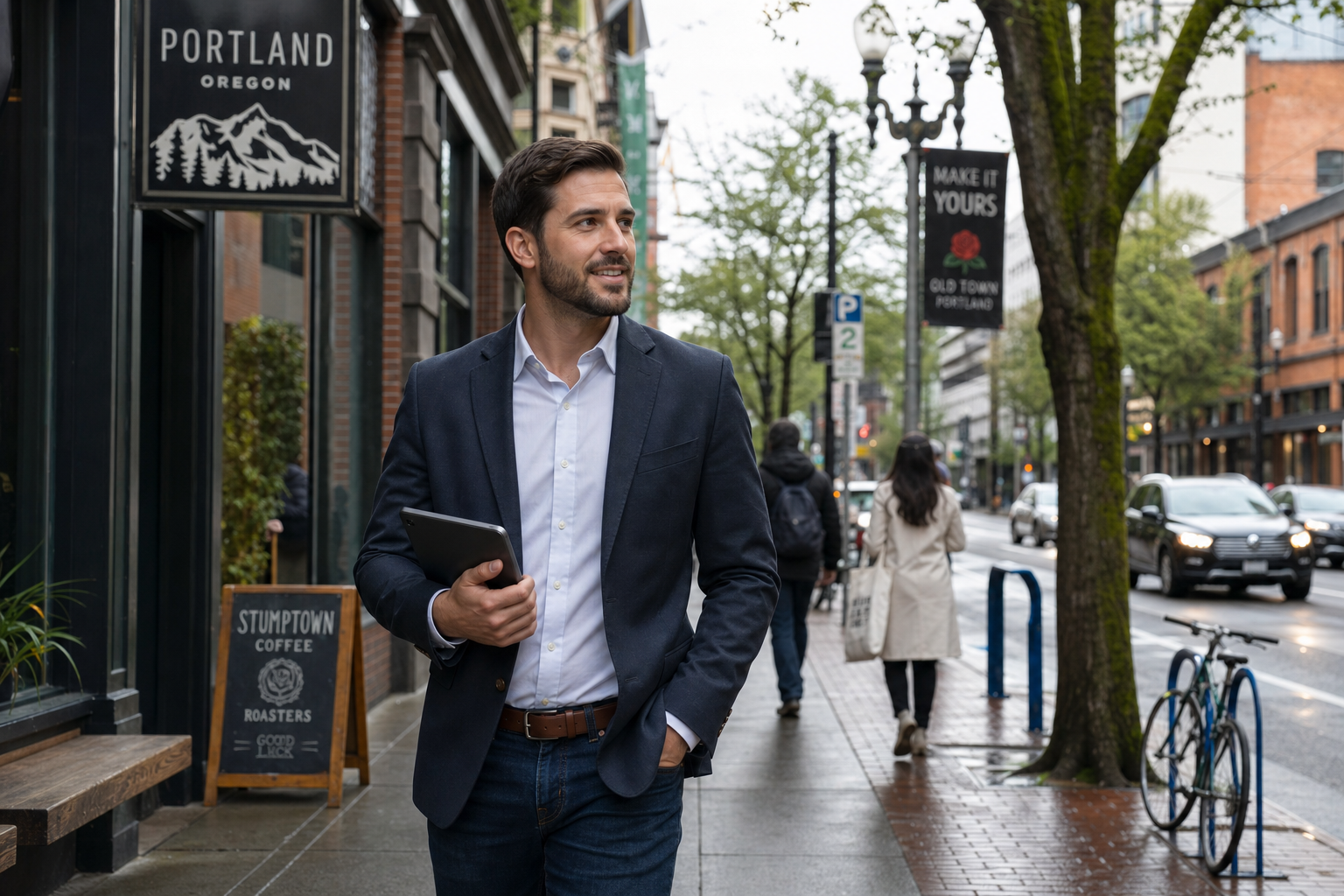
For Oregon local businesses trying to grow their client base, the question is rarely which approach is better in the abstract. Door-to-door outreach and digital lead generation both work, and both fail when misapplied. The real question is which fits your business model, your available time, and the type of relationship your customers expect before they hire you. Understanding where each approach is strongest helps you allocate effort more deliberately and build a pipeline that holds up over time.
What door-to-door outreach does well
Direct, in-person outreach creates a kind of proof that digital channels struggle to replicate: you showed up. For a cleaning company visiting a commercial property, a landscaper stopping by a neighborhood, or a contractor walking a business district in Portland, the physical presence signals investment and confidence in your own work. A decision-maker who sees you in person has already experienced one data point about how you operate.
Door-to-door also compresses the timeline from introduction to conversation. You are not waiting for someone to find you in search, click through, read your site, and decide to reach out. You are already standing in front of them. For businesses with a short sales cycle or a service that benefits from an on-the-spot demonstration, that immediacy matters.
The limitation is scale. Each in-person visit requires time, transportation, and the willingness to absorb a high rate of not-interested responses before finding qualified prospects. In dense Oregon metro areas like Portland or Eugene, a productive canvassing route can surface several viable leads in a day. In lower-density areas, the same effort might yield far fewer contacts. The cost per conversation is real.
What digital lead generation does well
Digital outreach reaches people at the moment they are actively looking for what you offer. A business owner in Beaverton searching for a commercial cleaning service at 9pm is expressing intent that no amount of door-to-door canvassing can reliably intercept. Search, local directories, and a well-structured website put you in front of that moment of intent without anyone on your team being awake or available.
Digital lead generation also compounds over time in a way that in-person outreach does not. A strong Google Business Profile, a set of useful location pages, a library of reviews, and consistent local search visibility keep generating inquiries while you are focused on delivering work. The effort invested in building that infrastructure pays forward into future months, unlike a canvassing day which produces leads only while it is actively happening.
The limitation is lag time. Building meaningful digital visibility takes months, not days. A brand-new business in Oregon cannot rely solely on digital channels in its first quarter and expect a full pipeline. Getting search visibility, review volume, and website authority to a level that reliably generates inquiries requires sustained effort before the results become predictable.
When door-to-door makes the most sense
In-person outreach earns its place when the target customer is a local business with an identifiable physical location, when your offer is specific enough to be pitched clearly in under two minutes, and when the decision to hire is made by someone who can often be reached at that location during business hours. Trades targeting commercial clients in Portland's industrial districts, service businesses canvassing established neighborhoods in Salem or Medford, and B2B services with a defined local territory all fit this profile reasonably well.
It also makes sense as a new business's early acquisition strategy before digital channels have had time to mature. Walking your target neighborhoods, introducing yourself, and collecting direct feedback about what local businesses actually need is a form of market research that no analytics tool can substitute for.
Francisco Labs helps Oregon businesses build digital lead systems that run while you focus on delivery: We design websites, local SEO foundations, and automation workflows that put your business in front of qualified prospects consistently, so in-person effort becomes a supplement rather than your only source of new work.
When digital leads should be your primary focus
Digital lead generation takes priority when your ideal customer is searching for your service online before making a hiring decision, when your service area is broad enough that physical canvassing is impractical, or when your team's time is better spent on delivery than on outreach. For residential service businesses across the Portland metro, most customers find vendors through Google, Yelp, or a neighbor recommendation before they ever speak to anyone. Meeting that customer where they are searching is the highest-leverage place to invest.
Digital also scales better as the business grows. Adding a new service area means updating a few web pages and a Google Business Profile, not hiring a canvassing team. For Oregon service businesses with ambitions beyond a single city, the digital infrastructure pays increasing returns as it expands.
The case for running both together
The businesses that build the most consistent local pipelines in Oregon tend to use direct outreach and digital channels in complementary roles rather than treating them as alternatives. Door-to-door generates quick conversations and immediate feedback. Digital visibility handles the inbound flow of customers who are already searching and ready to hire.
A practical way to think about the combination: use in-person outreach to open relationships in specific neighborhoods or commercial areas where you want to build density, and use digital channels to capture everyone who is searching for your service type in those same areas. When someone you met in person later searches online and finds your business at the top of local results, your credibility compounds in a way that neither channel alone could achieve.
For small Oregon service businesses managing both with limited time, the priority order is usually to get the digital foundation right first, since it works around the clock without your involvement, and then layer in targeted in-person outreach in the specific areas where you want to accelerate. That sequence builds a system rather than a dependency on any single source of new work.
Ready to build a lead system that works while you work?
Francisco Labs designs the digital infrastructure Oregon service businesses use to generate consistent local inquiries, so in-person effort becomes a multiplier rather than a necessity. Let's build your pipeline.
Start a Project