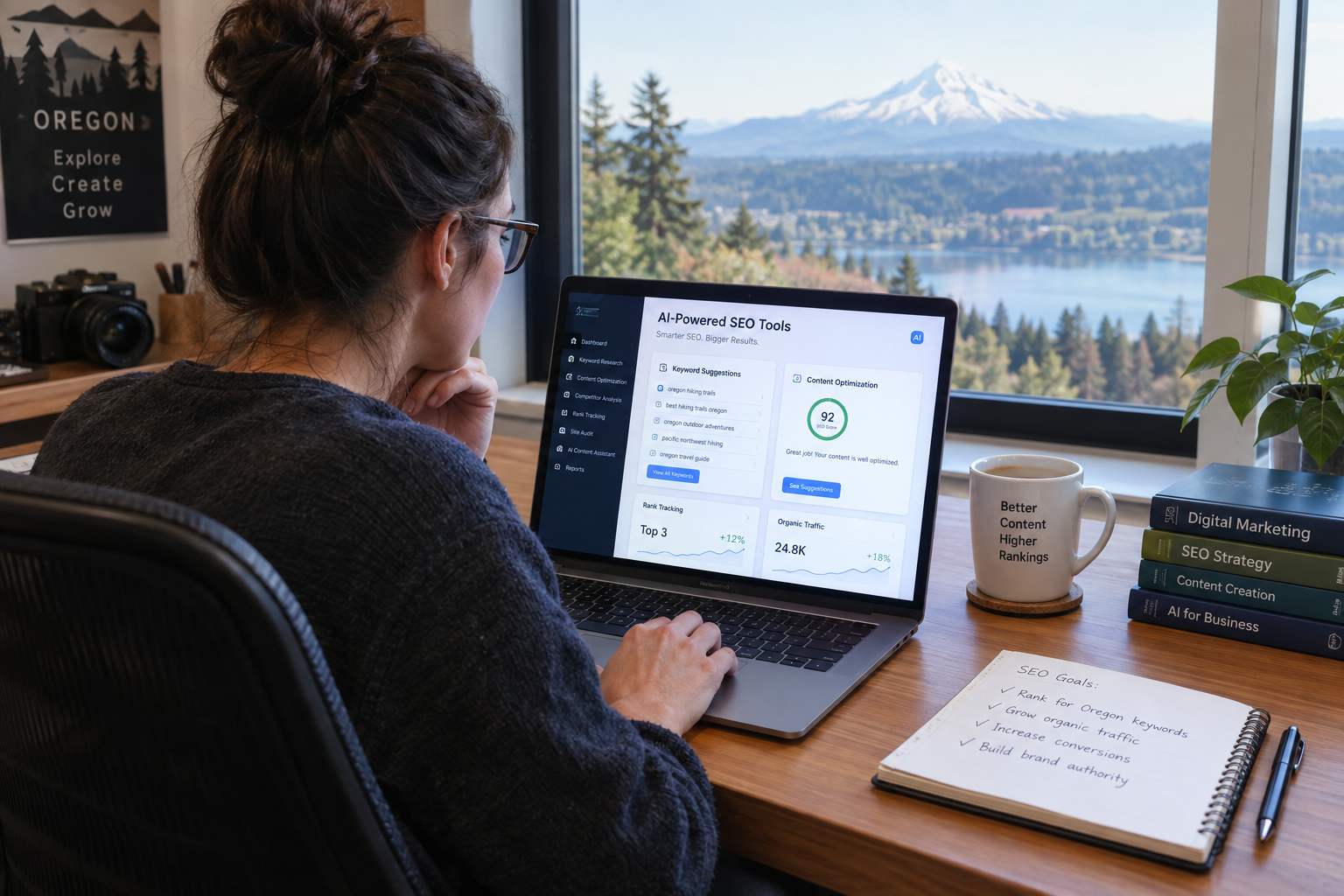
AI-driven search has fundamentally changed what it means to be visible online, and for Oregon local businesses, the rules that worked two years ago are no longer sufficient. Search engines now synthesize answers from multiple sources and present them directly to users, often before anyone clicks through to a website. This means that ranking on the first page of results is no longer the only goal. Visibility in 2026 requires being the source that AI systems trust, cite, and surface when someone in Portland, Eugene, Medford, or Bend is looking for what you offer. Understanding how that works is the first step toward building a presence that holds up in this new environment.
How AI search works differently than traditional SEO
Traditional SEO was built around a relatively simple model: optimize your pages for keywords, earn links, and climb toward the top of a list of results. Users would scan that list and click through to the sites that looked most relevant. The click was the metric that mattered, and the website was the destination.
AI search changes that dynamic in several ways. Large language models and AI-assisted search features now read, synthesize, and summarize content from across the web before presenting a response. In many cases, users get a direct answer without clicking anywhere. The businesses that benefit most are those whose content is clear, authoritative, and structured in ways that make it easy for AI systems to extract and cite accurate information.
For local businesses in Oregon, this matters because a prospective customer asking an AI assistant "who does commercial cleaning in Portland" or "best landscaping company near me in Bend" is getting an answer that was constructed from web content, Google Business Profile data, review signals, and structured business information. If your digital presence is thin, inconsistent, or poorly organized, you may be invisible in that answer even if you show up somewhere in traditional organic results.
What AI systems look for in local business content
AI search systems prioritize content that is accurate, specific, and genuinely useful to the person asking the question. Generic service descriptions and keyword-stuffed pages perform poorly in this environment. What performs well is content that clearly states what you do, who you serve, where you serve them, and why customers choose you over alternatives.
For Oregon local businesses, this means that your website and business listings should be built around honest, specific claims rather than vague marketing language. A cleaning company that serves the Pearl District and Northwest Portland, specializes in post-construction cleanup, and has been operating for eight years should have that information clearly stated across its website, Google Business Profile, and any other platforms where it appears. AI systems synthesize from multiple sources, so consistency and specificity across all of those sources reinforces your authority as a local provider.
Structured data, which is code added to your website that explicitly labels information like your business name, address, phone number, service areas, and operating hours, helps AI systems read your content accurately. This is not a new concept in SEO, but its importance has grown significantly as AI-assisted search relies more heavily on machine-readable signals to identify and categorize local businesses.
The role of reviews and local signals
Reviews have always mattered for local search visibility, but their role in AI-driven search is more direct than ever. AI systems treat review content as a primary signal for what a business actually does, how it performs, and who its customers are. A business with a rich body of detailed, recent reviews is giving AI systems a large sample of real-world evidence to draw from when constructing responses about local providers.
For Oregon businesses, this means that review acquisition is no longer just a conversion tool. It is a core part of your AI search visibility strategy. The words your customers use in reviews, the services they mention, the neighborhoods they reference, and the problems they describe you solving all feed into how AI systems understand and categorize your business. A landscaping company whose reviews consistently mention "Bend," "irrigation system repair," and "year-round maintenance" is establishing a clear, machine-readable identity around those terms.
Beyond Google, AI systems draw from a variety of sources including Yelp, industry directories, local news coverage, and community platforms. Building and maintaining consistent presence across these sources strengthens the overall signal that AI systems use to evaluate your local authority.
Francisco Labs builds the digital foundations Oregon businesses need for AI search visibility: From structured website content and Google Business Profile optimization to review systems and local SEO strategy, we design the infrastructure that positions local businesses as the authoritative answer in AI-driven search. If you want your business to be the one AI cites, let's talk.
Content strategy for AI-era local visibility
The content that performs best in AI-driven search is content that answers specific questions clearly and completely. For Oregon local businesses, this means building out the parts of your website and blog that address the actual questions your prospective customers are asking, rather than writing generic content about your industry category.
A roofing company in Salem that publishes detailed content about storm damage assessment, Oregon building permit requirements for roof replacement, and how to evaluate contractor bids is creating the kind of specific, locally relevant content that AI systems recognize as authoritative for that market. This content does not need to be long. It needs to be accurate, specific, and genuinely useful to the person asking the question.
Locally focused content also signals geographic relevance to AI systems. Mentioning specific Oregon neighborhoods, cities, and regions in the context of real service delivery, not just as keyword insertions, builds the location specificity that helps AI systems connect your business to searches with local intent.
Technical foundations that still matter
While the surface-level rules of SEO have shifted, the technical foundations remain important. Page speed, mobile usability, secure connections, and clean site structure are still baseline requirements for being indexed and evaluated by search systems. AI-assisted search engines still rely on the same crawling and indexing infrastructure as traditional search, which means technical problems on your website can prevent AI systems from reading your content at all.
For Oregon small businesses that built their websites several years ago and have not invested in technical maintenance, this is worth auditing. A site that loads slowly on mobile devices, has broken internal links, or lacks basic structured data is operating at a significant disadvantage relative to competitors who have invested in keeping their technical foundation current. The good news is that these issues are generally fixable with targeted work rather than a complete rebuild, and addressing them creates compounding benefits as AI-driven search continues to grow in importance across every market where Oregon businesses compete.
Want your Oregon business to show up in AI search?
Francisco Labs builds the websites, content systems, and local SEO foundations that make Oregon businesses visible in AI-driven search. Let's build your presence the right way.
Start a Project